

An IT architecture is not just a technical diagram or a list of tools. It is what enables applications, data, infrastructure, and security to work together seamlessly.
Key points:
- Architectural decisions should be based on business needs, not on trendy technologies;
- The more interdependent the components are, the more difficult it becomes to scale the system;
- Security must be considered from the outset, not added at the end of the project;
- Resilience always involves striking a balance between availability, costs, and complexity;
- Architecture has value only if it is understood, documented, and regularly updated.
What is IT architecture?
What does the concept of IT architecture encompass?
IT architecture, or information system architecture, describes how an organization’s IT components are organized and work together. In particular, it answers the following questions:
- What apps do we use?
- Where is the data stored?
- How do systems communicate?
- What servers, networks, or cloud services are required?
- How can we ensure the system’s security, reliability, and scalability?
Above all, an IT architecture is organized around several complementary layers:
- functional architecture,
- application architecture,
- data architecture,
- technical architecture.
Security and governance are also cross-cutting dimensions that apply to all of these layers.
👉 You might be interested in our article on digital sovereignty.
👉 You might be interested in our article on data governance with artificial intelligence.

What is the role of IT architecture in a company?
Its main purpose is to prevent the information system from becoming a disjointed jumble of software, data, and makeshift solutions.
Exemples :
- avoid buying three tools that do almost the same thing;
- reduce the risk of system failures, security breaches, and data loss;
- make it faster to integrate projects;
- minimize hidden costs associated with interfaces, duplication, and maintenance;
- Prepare for upcoming changes: cloud computing, AI, mergers, growth, new regulations, etc.
A company can operate without an architecture. Many even operate that way for a long time. But the more it grows, the more it accumulates technical debt, duplicates, and dependencies it doesn’t understand.
💡 So, is it essential?
For a small business with just a few simple tools: not necessarily.
For a medium- or large-sized company with many applications, data sets, business units, and service providers: yes.
The real issue is having someone who keeps an eye on the big picture and can ask, “Does this new project fit in well with what we already have, or will it create a costly problem in two years?”
Good architecture saves time and prevents errors. Poor architecture, on the other hand, mainly results in documents that no one reads.
👉 Check out our case study here to learn how Qim info modernized the IT infrastructure of a major automotive group in Geneva.
What are the main types of IT architecture?
These different types of architecture do not operate in isolation. The breakdown may vary by organization, but the five categories we propose provide a framework for understanding the main levels.
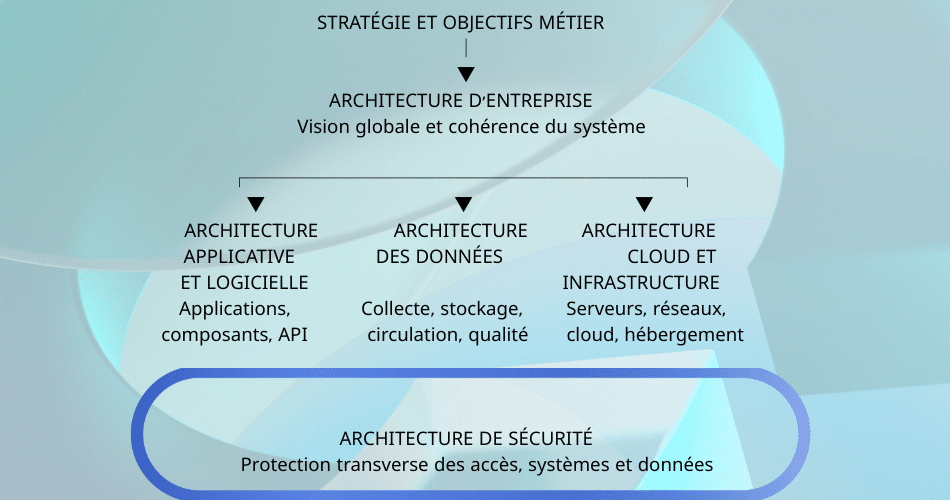
Enterprise Architecture
What is it?
It is a comprehensive view of how a company operates through its information system. It connects four elements:
- the company’s strategy;
- business processes;
- the applications used;
- data and technical infrastructure.
What is its purpose?
It is about ensuring that the information system truly supports the company’s priorities. It helps avoid redundant tools, poorly integrated systems, and technology investments that do not meet business needs.
Example
A company wants to increase its online sales. Enterprise architecture is used to determine which processes need to change, which applications are affected, how data flows, and what technologies are required.
Application and Software Architecture
What is it?
Application architecture focuses primarily on the relationships between applications, while software architecture focuses on the internal structure of a software program.
There are several styles, models, and patterns used to design software applications and systems. Among the most common are:
- client-server architecture;
- centralized or distributed architecture;
- monolithic architecture;
- microservices architecture;
- service-oriented architecture, or SOA;
- layered architecture;
- event-driven architecture;
- the serverless model;
- design patterns such as MVC (Model-View-Controller).
These concepts are not all at the same level.
Some describe an application’s overall structure, while others describe the internal organization of its code, the interactions between its components, its execution model, or its deployment model.
They are not necessarily mutually exclusive.
Example: A single application can be client-server, organized into layers, use the MVC pattern, and be deployed in the cloud.
What is its scope?
It covers the applications used by the company, their interactions, data flows, APIs, technical dependencies, and the internal organization of the software. It can apply to either an entire system or a specific application.
What is its purpose?
Its goal is to ensure that applications function consistently. It helps prevent duplication, overly strong dependencies, and difficulties during technical upgrades.
Example
A company uses an e-commerce site, a CRM, an inventory management tool, and invoicing software.
The application architecture defines how these solutions exchange data.
The software architecture specifies how the e-commerce site is structured to manage customer accounts, orders, payments, and products.
Data Architecture
What is it?
Data architecture describes how data is collected, organized, stored, used, and shared within an organization. In other words, it organizes the data lifecycle.
What is its scope?
It covers data sources, databases, data flows between applications, quality rules, access rights, data retention, and data governance.
What is its purpose?
Its goal is to ensure that data is reliable, accessible, secure, and usable. It also helps prevent duplicates, inconsistencies, and the fragmentation of information across multiple systems.
Example
A company stores customer data in its CRM, e-commerce site, and billing system. The data architecture defines how this information is synchronized, which source serves as the reference, and who can access it.
Cloud Architecture and Infrastructure
What is it?
Cloud and infrastructure architecture describes the technical resources required for the information system to function.
What is its scope?
It covers:
- on-premises, cloud-based, or hybrid infrastructures,
- networks,
- computing capabilities,
- storage,
- service availability,
- backup,
- disaster recovery.
What is its purpose?
Its goal is to provide a reliable technical foundation. It allows resources to be tailored to the company’s needs while minimizing service interruptions and unnecessary costs.
Example
A company hosts its e-commerce site in the cloud. The cloud architecture and infrastructure define how to distribute the load, automatically scale resources during traffic spikes, back up data, and maintain service availability in the event of an outage.
Security Architecture
What is it?
A security architecture defines how systems, applications, data, and access are protected against internal and external risks.
What is its scope?
In particular, it covers:
- identity and access rights management,
- network security,
- encryption,
- application security,
- incident monitoring,
- backups
- and compliance rules.
What is its purpose?
Its goal is to reduce the risk of data breaches, unauthorized access, fraud, or service interruptions. It also aims to ensure the confidentiality, integrity, and availability of information.
Example
A company wants to secure access to its internal systems. The security architecture may include multi-factor authentication, role-based access controls, network segmentation, and monitoring for unusual connections.
What are the different roles in IT architecture?
What is the role of an IT architect?
The role of an IT architect is to maintain a big-picture view of a company’s IT system.
Specifically, it helps you decide:
- which solutions to use;
- how applications should communicate;
- where to store the data;
- how to avoid duplicates and inconsistencies;
- How to ensure the system’s security, reliability, and scalability.
He doesn’t necessarily develop all the solutions himself. His role is primarily to define the framework, ensure that decisions are consistent, and prevent a project from creating problems elsewhere.
💡”IT architect” can be a generic term that refers to all roles related to IT architecture.
What are the main areas of specialization?
In a small business, a single person may hold multiple roles. In a large organization, responsibilities are more clearly separated.
Enterprise Architect
It operates at the most comprehensive level. It seeks to align business needs, the organization, processes, applications, data, and technologies.
His main question is: How should the information system evolve to support the company’s strategy?
Software Architect
He is primarily interested in the internal structure of software: component breakdown, code organization, performance, maintainability, and the choice of development technologies.
His main question is: How should the software be designed internally?
Cloud Architect
He designs the use of cloud services: hosting, networking, storage, resilience, costs, automation, and sometimes migration to the cloud.
His main question is: How do we deploy and operate systems in the cloud?
Data Architect
He or she oversees the collection, storage, exchange, quality, and use of data.
The main question is: How should data be shared, structured, and governed?
Security Architect
He defines security principles and measures: access management, data protection, segmentation, encryption, traceability, and risk management.
His main question is: How can we protect the system and reduce risks?
💡How can you avoid confusion? The easiest way is to always specify three things:
- Scope: the entire company, a project, an application, or a technical area.
- The decision-making level: strategic, overall design, or detailed design.
- Area of expertise: software, data, security, cloud, or infrastructure.

What skills and tools are needed to work in IT architecture?
Technical Skills
An IT architect must understand the main components of an information system: applications, data, infrastructure, networks, the cloud, and security.
He must also know:
- analyze the interactions between these elements,
- identify dependencies,
- Assess the impact of a technical decision on the system’s performance, resilience, scalability, and maintainability.
He does not need to have a detailed understanding of every technology. His role is primarily to have a broad enough technical perspective to compare solutions, anticipate risks, and make decisions that align with the company’s needs.
Professional and interpersonal skills
An IT architect doesn’t just work on technical issues. In particular, they must know how to:
- understand business needs in order to align technical decisions with the company’s objectives;
- rephrase expectations in order to transform what may be a vague need into clear requirements;
- communicate with a wide range of people, from technical teams to decision-makers;
- weigh various options while taking into account costs, risks, and priorities;
- facilitate collaborationbetween business units, developers, infrastructure teams, and security teams;
- present and defend one’s choices in a clear and well-reasoned manner.
Methods and Standards
Some of the most common ones are:
- TOGAF helps organize an enterprise architecture process;
- ArchiMate allows you to model processes, applications, data, and infrastructure;
- ITIL links architectural decisions to IT service management;
- COBIT provides a framework for information system governance and control.
These frameworks are not used in the same way across all companies. The architect selects the ones that are appropriate for the context, the size of the organization, and the project’s objectives.
In addition, agile methods such as Scrum, Kanban, and DevOps are generally highly valued.
Essential Tools for IT Architects
Modeling, Strategy, and Organizational Tools
- Diagrams (Lucidchart, Draw.io, Visio),
- Modeling, Mapping (Merise, Axial, IDEF, UML, SAD, Diagrams.net),
- C4 Modeling (Context, Container, Component, Code),
- Linking Strategic Objectives to Performance Metrics (Balanced Scorecard)
- Data Management Platform (DMP) for managing large volumes of data (Collibra),
- DevOps and CI/CD: Jenkins, GitLab CI, GitHub.
Cloud Tools and Infrastructure
- Infrastructure as Code (Terraform),
- Orchestration and containerization (Docker, Kubernetes),
- Cloud design and monitoring (AWS (Redshift, Glue), Azure (Synapse, Data Factory)).
Tools for Integrating Security
- Security Monitoring (Splunk).
- Vulnerability analysis (Nessus / Qualys).
- Compliance audit (OpenSCAP / Lynis).
- GCP cloud services (BigQuery, Dataflow).
Data Management Tools
- Database management systems: SQL Server, Oracle, PostgreSQL, MySQL, MongoDB, Cassandra, Redis (NoSQL).
- ETL/ELT Data Flow Management & Data Pipelines (Talend).
- Visualization and reporting (Power BI, Tableau).
- Data Governance and Cataloging (Collibra / Alation).
- Big Data & Data Lake: Hadoop, Spark, Hive, HDFS, Cloud Storage (Amazon S3, Azure Data Lake, Google Cloud Storage).
How can we design a high-performance and sustainable IT architecture?
Aligning Architecture with Business Strategy
The keys to aligning architecture with business strategy:
- Identify the company’s strategic priorities and objectives (Innovation, Cost Reduction, Revenue Growth, Improving the Customer Experience, Regulatory Compliance)
- Map the architecture of information systems, current IT investments in projects, systems, and resources, as well as budgets, in order to assess whether investments are aligned with the company’s strategy and business needs, evaluate return on investment, and prioritize projects
- Readjust the alignment and prioritization of projects
- Communicate new guidelines and adjustments to the business units and IT
- Monitor progress on alignment and its impact on strategic performance using:
- Strategic dashboards to ensure that IT projects align with the company’s strategic objectives
- Alignment matrices (IT strategy, impacts, risks) to map IT projects or investments and their contribution to the company’s strategic objectives
- Change, priorities, and risks are part of our daily lives, so it is essential to regularly review our mapped IT investments in order to monitor them and adjust them as necessary to align with new strategic directions.
Designing a Scalable and Resilient Architecture
A scalable architecture can accommodate new use cases, increased traffic, or new services without requiring a complete overhaul. A resilient architecture continues to provide essential functions despite a failure or incident.
To achieve this, the following steps are particularly important:
- decouple components so that part of the system can be updated without changing the whole system;
- define stable interfaces and APIs to limit dependencies between applications;
- identify critical services and set an appropriate availability level for each one;
- eliminate single points of failure in critical components;
- plan for redundancy, backups, and disaster recovery;
- set up monitoring and alerts to quickly detect performance degradation;
- test failure and recovery scenarios rather than assuming that the mechanisms will work;
- Tailor resilience measures to the risks involved, since high availability also increases costs and complexity.
Building Security into the Design from the Start
In practical terms, this involves, among other things:
- apply the principle of least privilege by limiting each access to only the necessary resources;
- segment systems and networks to reduce the impact of a security breach;
- encrypt sensitive data, both during storage and during transmission;
- secure interfaces and APIs using authentication, authorization, and input validation mechanisms;
- centralize logging and monitoring to detect abnormal behavior;
- keep components up to date and manage software dependencies;
- Regularly test security through architectural reviews, vulnerability assessments, and penetration tests.
An approach DevSecOps allows for the automation of some of these checks throughout the development cycle.
How Qim Info Supports Your IT Architecture Projects
When you partner with Qim Info, you’ll receive expert guidance to help you choose the right architecture aligned with your company’s strategy. Our teams can assist with a variety of projects, such as:
- Improving your information systems,
- The migration of legacy workflow systems and applications to scalable and adaptable systems,
Contact our experts to discuss your IT architecture projects.