
Accelerating deployments without sacrificing quality: that is the whole point of CI/CD. When designed well, a pipeline enables more frequent deliveries while detecting errors and vulnerabilities as early as possible.
- CI/CD covers compilation, testing, analysis, delivery, and, where applicable, deployment to production.
- Continuous integration, continuous delivery, and continuous deployment refer to three distinct levels of automation.
- A pipeline is reliable only if its safety tests and inspections are also reliable.
- The main benefit is the speed of the feedback.
- The effectiveness of CI/CD also depends on practices, not just tools.
Take Back Control of Your Cloud
Definition of CI/CD
Historically, the production release rate for an application is around one major update every 3 to 6 months… which is a very long time.
In a DevOps If you’re looking to reduce your time-to-market, you’re probably wondering what would be an effective way of speeding up the process. This is where CI/CD comes into play, a method that seeks to automatiser et accélérer le développement de logiciels.
Le terme CI/CD est composé de deux acronymes, pour deux étapes importantes :
- CI for Continuous Integration, or Continuous Integration in French;
- CD for Continuous Delivery and Continuous Deployment, or Continuous Delivery and Continuous Deployment in French.
Developing an application is often a long and tedious process, divided into many successive steps.
The CI/CD approach thus accelerate the frequency of releasesby automating the various stages of development and by monitoring every stage of the of applications.
💡 You might be interested in our article on cloud architecture or the one on digital sovereignty.
Take Back Control of Your Cloud
What is continuous integration?
CI (or Continuous Integration) therefore represents the automation of development processes.
This is how developers will test and implement smaller iterations at more regular intervals, rather than rolling out major changes on a more sporadic basis.
Are you a developer working on a feature who needs to have your code reviewed before deploying a new version? CI helps manage part of the delivery process by ensuring that your unit tests are run.
In this context, the CI plays a crucial role in merger or pull requests (MR/PR). It ensures not only that your unit tests are executed, but also that the code is kept clean and bug-free, guaranteeing a smooth transition to production release.
These various recordings of small subsets will then be published on a SCM TOOL, or Source Code Management Tool. This tool centralizes all changes as they occur and manages all updates. One example is the very popular GIT.
The pipeline (the set of steps involved in software development as part of a CI/CD strategy) builds the software from the source code present in the source code manager, known as “build” (compilation of executable code).
A series of automated tests is then performed to check the quality of the code, its behavior and the interactions between each coded subset. If an error is detected, this is when the developers are notified and can intervene.
The new build is then archived in the repository, ready for deployment!
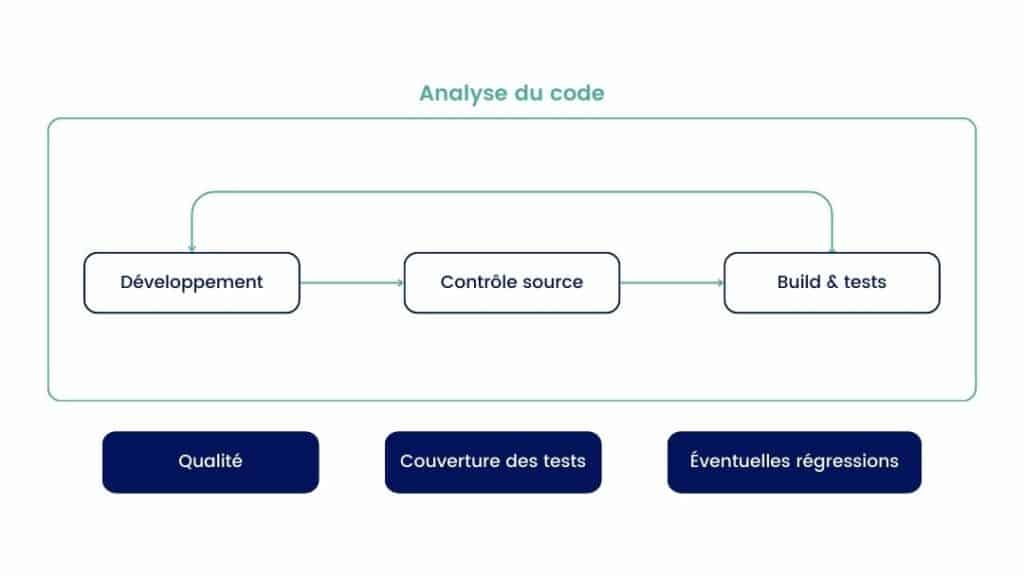
Code analysis through CI allows developers to systematically monitor code quality, test coverage, potential regressions, and more.
This concept is very interesting and important: CI helps maintain—or even improve—code quality. If your tests are inconclusive, it means that one of your features is not behaving as expected.
On the other hand, code analysis—and especially code coverage—will let you know whether your code has been unit-tested. This creates an ecosystem that makes development more reliable by detecting problems as early as possible; this is what’s known as “shift left.”
What is continuous delivery?
The next step is Continuous Delivery (CD). It can be considered as a phase of preparation before the software is deployed.
Its goal is to ensure that the code is always ready for release. To do this, we need to implement automated quality and functional tests that are integrated into the continuous integration workflow.
Cette étape englobe divers tests tels que :
- l’interface,
- la charge,
- l’intégration
- et la fiabilité de l’API.
This approach allows developers to thoroughly review updates to identify potential issues that need to be resolved before deployment.
Our teams at Qim info aim to help you speed up the development process and make it more reliable, so you can quickly deliver value to users.
We also offer tools for continuous testing to ensure that the program meets its requirements.
The more experienced among you will even be introduced to an additional step, the other CD: Continuous Deployment. Continuous Deployment. C’est l’étape suivante, où même le processus de déploiement de l’application est automatisé.
But deploying without human intervention is no mean feat: it requires great confidence in the process, the ability to deploy without interruption, and a responsive monitoring system coupled with effective repair solutions, such as automated rollbacks.
What is the difference between CI and CD?
CI (Continuous Integration) and CD (Continuous Delivery) are the two successive stages of the same operational method.
First, CI, which covers the automation of building, testing, and packaging the deliverable.
Then CD, which is designed to manage the deployment and production rollout of the application.
These two approaches are complementary and, together, enable us—from a DevOps perspective—to automate and accelerate all application development processes.
What is a CI/CD pipeline?
The pipeline is the set of steps used to develop software as part of a CI/CD strategy. The aim is to automate processes and make them faster and more reliable.
While the specific stages vary from company to company, the structure of a pipeline often remains the same:
- Development each developer works simultaneously on a different feature or iteration of the source code.
- Build: all new code validated in the repository (GIT) is collected, validated and compiled.
- Test The compilation goes through a series of automated tests to ensure that it works properly. Most often, they are unit testing, where the code is broken down into small, individually-tested units.
- Analysis Code analysis: in-depth code analysis to obtain metrics on code quality, code smelling, CVE dependencies and technical debt calculation.
- Delivery: the application is distributed to the repository which stores the builds, or pieces of code (dependencies) you created during the CI (Continuous Integration) phase, build artifacts created by continuous integration.
- Deployment: once the code has been verified by unit tests and user acceptance tests (UATs) and everything is ready for distribution, the project is sent to a deployment environment. These are usually additional simulations and checks, and each manually approved change is sent to production.

An efficient pipeline must be fast, reliable and precise It must optimize developer workflows.
What are the advantages of CI/CD?
As we said earlier, developing an application is often a long and tedious process. The CI/CD allows you to and speed up the process. in this process.
Continuous integration and continuous delivery allow you to release updates more frequently, without compromising quality.
Repetitive tasks are therefore taken care of automatically allowing your developers to concentrate on development tasks.
However, it is essential to understand that CI/CD is not a magic solution: its effectiveness depends on the relevance and rigor of the automated tests that are implemented. A good automated test is designed to detect and handle every error before compilation and deployment. But if these tests are not well-designed or do not cover all features, bugs may remain in the code. It is therefore crucial to ensure the quality of the tests to guarantee the effectiveness of this method.
Which tools make up the CI/CD?
CI/CD tools play an important role in ensuring that each stage of the pipeline runs smoothly. Here is a list of the most commonly used tools:
- Jenkins a free, open-source java server for continuous integration.
- Gitlab CI/CD a suite of tools that allows you to set up CI/CD pipelines for any new or pre-existing Git-based project.
- Github Action:sometimes seen as a strong competitor to Gitlab CI, Action is a Github-developed tool that works only in the Github environment.
- Bamboo Bamboo: integration, deployment and continuous delivery software that brings together and automates builds, tests and releases in a single workflow.
- Azure Pipeline : orecent utility developed by Microsoft for Azure DevOps repositories. It has the advantage of being integrated into the Azure ecosystem.
- Circle CI a highly customizable CI solution. Its strong point: it supports a wide range of programming languages (Java, Python, JS, Haskell, Ruby on Rails and Scala).
- ArgoCD an open source continuous deployment tool based on GitOps, enabling automatic synchronization of Kubernetes applications with Git repositories.
These tools are the most widely used on the market. However, other tools—such as Nevervode, AppVeyor, Buddy, and others—sometimes offer innovative approaches and easier integration into an existing project.
Nos équipes sauront être à l’écoute de vos besoins pour vous orienter vers les outils les plus adaptés à votre organisation !
CI/CD pipelines guarantee application quality and security
Quality and safety are two essential elements in software development. In this context, CI/CD pipelines play a key role, as they provide a mechanism for verifying and guaranteeing both these aspects.
Application quality
Definition
Application quality refers to software reliability, performance and maintenance. :
- Reliability Reliability: ensures that the software works as expected, without errors or critical bugs.
- Performance Guarantees that the application meets response time requirements, manages memory and resources efficiently, and evolves as needs change.
- Maintenance Maintenance: facilitates future developments, whether to add functionality, fix bugs or update in response to new requirements or technologies.
The CI/CD pipelines contribute to quality by automating testing at every stage of development and ensure that changes made do not generate new problems.
SonarQube:
One of the leading tools for ensuring code quality is SonarQube. It provides continuous code analysis to detect bugs, code smells and security vulnerabilities.
Regardless of the programming language used, SonarQube provides language-specific rules to ensure the highest possible quality.
It integrates easily with CI/CD pipelines, enabling real-time analysis with every pull request or continuous integration.
What’s more, with a detailed dashboard, teams can track the evolution of code quality over time and know where to focus their efforts.
Application security
Definition
Security is crucial to protect data and resources from external threats. It is based on :
- Access management Access management: authorizations and roles must be clearly defined so that only authorized people can make changes or deploy code.
- Protecting sensitive information Sensitive information, such as API keys or passwords, must be stored securely and never exposed or stored in the clear.
- Regular checks New updates or tools can potentially introduce vulnerabilities. Regular safety audits and checks are essential to anticipate and prevent such problems.
As such, CI/CD pipelines play an essential role by integrating security monitoring and analysis tools, which ensure that the code is free of vulnerabilities and meets security standards.
Snyk
In terms of tools, while SonarQube focuses on overall code quality, Snyk focuses on code security, particularly with regard to dependencies.
Snyk monitors your application’s dependencies for known vulnerabilities and alerts developers as soon as a threat is detected.
Beyond simple detection, Snyk offers automated fixes in the form of pull requests, which speeds up the resolution process.
Whether you use GitHub, Bitbucket or GitLab, Snyk integrates seamlessly with your tool to monitor every branch and pull request.
What are the differences between CI/CD and DevOps?
The professionals we support regularly ask about the difference between Devops and CI/CD.
DevOps is an approach and even a culture culture which brings together two professions – developers and the operational team – to make software development more efficient. As for CI/CD, it’s a process a specific automation process with its own steps and tools, integrated into the DevOps approach.
In other words, CI/CD is a process that is part of a DevOps cultureculture, but is only a small part of it, as it encompasses many other aspects of how a company operates in software development.
I've got a pipeline, so it's all good?
A CI/CD vision is a very interesting approach to automating most of the processes a developer would have to manage. It also acts as a safeguard, stopping an “underground” deployment if it doesn’t meet the required quality or if a test fails.
However, a pipeline is just a tool! Always pay attention to the project, your needs and your requirements. If your tests don’t work, your pipeline won’t help!
Take Back Control of Your Cloud
Our guide to integrating a CI/CD pipeline
Integrating a CI/CD pipeline is an essential part of modernizing development practices. If implemented correctly, it can transform the way teams develop and deploy software, promoting efficiency, speed and quality.
Principles
Implementing a CI/CD pipeline requires adherence to certain principles:
- Automation: The very essence of CI/CD lies in the automation of testing, builds, and deployments.
- Collaboration: Teams must work closely together, share code frequently, and resolve issues quickly.
- Quick feedback: The idea is to get feedback on the code as quickly as possible so that errors can be identified and corrected promptly.
Choice of tools
When it comes to CI/CD, the choice of tools will often depend on a company’s specific needs and the technological environment in which it operates. Solutions such as GitLab CI are particularly well-suited. Jenkins, although no longer the most widely used tool today, has also made its mark on the history of CI/CD. The key is to choose a solution that aligns with the company’s overall strategy and optimizes the development and deployment process.
Make sure the tools you choose are compatible with the technologies and platforms you already use. The tools should be able to scale with your needs, especially if your team or codebase grows.
Among the tech giants, Amazon, Google, and Microsoft each offer their own solution: AWS CodePipeline, Azure Pipelines, and Google Cloud Build.
Nevertheless, Google’s solution is far less common than the other two.
Infrastructure
Do you want to deploy to a publiccloud, a private cloud, a local server, or a combination of these options?
Your choice will affect the configuration of your pipeline. To ensure consistent availability, you may need to use backup servers or clusters to manage workloads.
Make sure that resources (such as memory or processing power) are properly allocated to avoid bottlenecks.
Tests
It is essential to have good test coverage to ensure that all of the code is verified and functions as expected.
Tests must be automated to ensure that they are run with every integration or deployment.
Test results must be promptly communicated to the developers so they can fix any issues.
In conclusion, in this guide we’ve covered everything you need to know to get started with CI/CD process creation. You now have all the tools you need to create your own pipeline, and automate and accelerate your development processes.
So, what are you waiting for? Our Cloud & DevOps Solutions team is here to help you build your own CI/CD pipeline!

Clément Raussin
Head of Cloud & DevOps Solutions at Qim info