

In this article, learn everything you need to know about cloud architecture—and what not to confuse it with.
Take Back Control of Your Cloud
What is cloud architecture?
“Cloud architecture” is a term that is often misused to refer to several different things.
In fact, there are at least four levels that need to be distinguished:
- Cloud deployment models: public, private, hybrid, and multicloud.
- Cloud infrastructure (IaaS): AWS, Azure, Exoscale…
- Cloud services (SaaS, PaaS, etc.): Microsoft 365, Google Workspace, Salesforce, etc.
- Cloud architecture: the way all these components are organized together.
Cloud architecture is, therefore, the company’s technical blueprint. It maps out all the technologies and components essential to the proper functioning of your information system in the cloud.
Example:
- application servers on Exoscale;
- Microsoft 365 for users;
- Veeam backups;
- VPN connection between headquarters and the cloud;
- PRA in a second data center.
👉 You might be interested in our article on cloud security, as well as the one on digital sovereignty.
What is included in a cloud architecture?
There are generally 7 main sections:
- Identity and AccessManagement (IAM): Control of users, roles, and permissions.
- Compute: virtual machines, containers, Kubernetes, serverless, or managed services that run applications.
- Storage and databases: object, block, or file storage, as well as the databases required by the applications.
- Network: private networks, routing, VPNs, load balancers, DNS, and firewalls that ensure connectivity and secure data transmission.
- Security: encryption, secret management, access protection, threat detection, and compliance.
- Monitoring and Operations: log collection, monitoring, alerts, and observability to keep services operational.
- Backup and Resilience: Backups, Data Replication, and Disaster Recovery Measures.
This is the approach that the leading cloud providers (AWS, Microsoft Azure, and Google Cloud) now adopt when outlining the fundamentals of a cloud architecture. However, they differ in the specific services they offer to implement each of these building blocks.
Cloud responsibility model
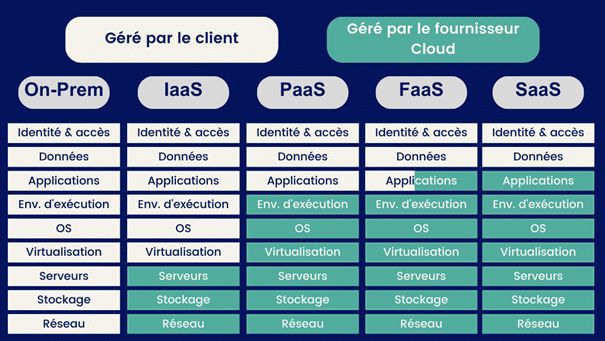
Depending on your company’s needs and constraints, choose between an IaaS (Infrastructure as a Service), PaaS (Platform as a Service), or SaaS (Software as a Service) model. These types of services vary depending on your needs: Do you want your cloud service provider to provide you with its infrastructure, turnkey tools to create your own applications, or ready-to-use cloud applications?
You can find more information in our article on the cloud.
What are the different types of cloud architecture?
There is no single classification of cloud architectures.
The problem stems from the fact that three elements are often conflated:
- Deployment models: public, private, and hybrid cloud;
- usage strategies: multicloud, distributed cloud;
- application architecture styles: serverless architecture, microservices, containerized architecture, three-tier architecture, etc.
We can talk about:
- cloud-native architecture;
- serverless architecture;
- microservices-based architecture;
- containerized architecture;
- hybrid architecture;
- multicloud architecture.
But not all of these categories are on the same level.
Example: A single company may have:
- a hybrid architecture (some resources on-premises, some in Azure);
- multicloud (Azure + Exoscale);
- with microservice-based applications;
- deployed on Kubernetes.

Do you need a cloud architect?
Certain situations related to your cloud environment may require the assistance of a cloud architect or a cloud engineer. Among these, the most common include:
- Difficulties in evolving your infrastructure as your organisation grows or experiences rapid growth. The cloud architect will adapt your infrastructure and propose improvement axes according to your challenges.
- Poor management of IT resources that compromises the performance of your cloud services but also causes excessive costs in use (FinOps). A cloud architect is able to identify bottlenecks and optimise your resources without compromising the performance of your Cloud environment.
- Defining security rules in your Cloud is also a task that a cloud architect can accomplish.
- Initiating a migration to the cloud, allocating resources across different services, or leveraging automated solutions for deploying and running your resources are all tasks you can entrust to your future cloud architect.
In addition to architecture, don’t forget to establish clear governance and processes for your teams.
Take Back Control of Your Cloud
Qim info: your cloud architect to support you
Have you identified blockages in your information system that could be optimised by implementing Cloud solutions?
At Qim info, our experts offer customized cloud consulting services tailored to your needs and your company’s specific context.
Our cloud architects help you design, build, migrate, and optimize your cloud infrastructure to transform the way you work, thereby reducing your time-to-market while ensuring the efficiency of your IT system. Qim info also offers support (maintenance, incident resolution, updates) for your cloud infrastructure.
Whether you choose a staffing-of-personnel model or a “project” model, working with an IT services company offers many advantages.
Benefit from the expertise of carefully selected cloud architects for the period necessary for the proper implementation of your cloud environment.
At Qim info, our team of specialists supports you every step of the way throughout your project:
- Conducting a feasibility study and cost analysis for migration to the Cloud: our multi-supplier experience allows us to define your new ready-to-use architecture, facilitate migration, and optimise costs.
- Kubernetes, Docker: We orchestrate your containers and microservices to ensure greater availability for your information system
- Real-time security and monitoring: We ensure the observability of your cloud environment to facilitate monitoring, analysis, and security. We implement tools such as WAF, SIEM, DLP, and a Zero Trust strategy.
Vos bénéfices :
- Boost your productivity
- Maximisez votre sécurité sur le cloud
- Améliorez la qualité de vos logiciels
- Reduce your costs
- Perfect observability
- Increase availability