
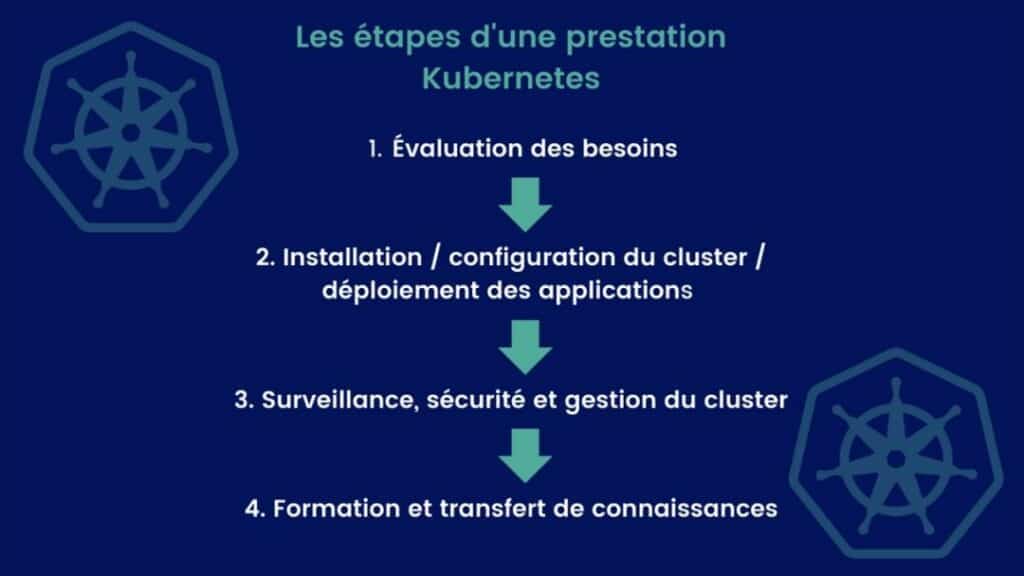
Of course, each Kubernetes service is unique! The steps below provide a general overview of the process, but details may vary depending on the complexity and requirements of your project.
Take Back Control of Your Cloud
The Steps of a Kubernetes Service
Do you need to switch to Kubernetes? Wondering how to choose the best expert? Qim info has the solution.
Let’s quickly recall that Kubernetes (or K8s) is one of the most well-known and widely used orchestrators, enabling the management of application containers in open source. This type of architecture offers great stability and flexibility for applications and software by facilitating their resilience and scaling according to the required load. To learn more, we refer you to the excellent article by our colleague Benjamin Calvet on Komodor, the next-gen Kubernetes console, in which he explains what Kubernetes is.
First, let’s look at the steps of a Kubernetes service.
Les étapes d'une prestation Kubernetes
Bien entendu, chaque prestation Kubernetes est unique ! Les étapes ci-dessous donnent un aperçu général du processus, mais les détails peuvent varier en fonction de la complexité et des exigences de votre projet.
Needs Assessment
As with any project, the first step is to assess the specific needs of your project. For this, the expert must understand your objectives, constraints, and requirements.
At this point, you have two essential considerations:
- On-premise installation or cloud hosting?
On-premise solutions have the advantage of freedom in managing and configuring Kubernetes on your infrastructures, while avoiding potential costs associated with a Cloud provider. As for hosted solutions, they are a very convenient way to create and maintain Kubernetes clusters. They free you from the task of managing and operating your clusters.
- Architectural Design
The architecture of your Kubernetes cluster includes elements such as node configuration, load balancing, storage management, security policies… The goal is to create a robust and scalable architecture tailored to your needs.
Take Back Control of Your Cloud
Cluster Installation and Configuration, Application Deployment
The expert then proceeds with the installation and configuration of the Kubernetes cluster. This includes setting up the nodes (physical or virtual) that will make up the cluster, installing Kubernetes on these nodes, and configuring necessary components such as the API Server, the Controller Manager, the Scheduler. Once the cluster is ready, the Kubernetes expert helps you deploy your applications.
Monitoring, Security, and Cluster Management
The Kubernetes expert helps you set up monitoring tools such as Prometheus, Grafana, or Kubernetes Dashboard. These allow monitoring performance, detecting potential issues, and maintaining cluster stability.
Similarly, the expert ensures security and implements access control mechanisms, authentication, and encryption of communications within the cluster.
Finally, they help you effectively manage the cluster resources by implementing resource management policies, such as horizontal pod autoscaling or the use of quotas.
Training and Knowledge Transfer
This step is optional depending on your need: do you want to fully delegate Kubernetes management after deployment, or keep control? Throughout the service, the expert can provide training to your team, enabling them to acquire the skills necessary to independently maintain and manage the Kubernetes cluster. This is indeed one of our strengths at Qim info: end-to-end project support, which naturally includes team training.
You now have the keys to understanding a Kubernetes service; we will now advise you on how to choose your expert.
How to Select the Best Kubernetes Expert?
Our Cloud & DevOps Solutions department, which is part of Qim info’s Centre of Expertise, offers you the best Kubernetes experts. You can contact us with the assurance that your project will be understood, defined, implemented, and followed up with great demand.
Indeed, selecting an expert is not simple. Will they be up to the task? Will they understand your needs? We have listed some selection criteria for you. Naturally, these are not checklist items to be ticked off at all costs. Your intuition remains crucial.

Experience and References

Look for information on your expert’s professional background, previous projects related to Kubernetes, and any relevant certifications or training. Do not hesitate to contact their previous employers or clients. An expert with solid experience will be an asset. But a promising young talent could also suit you!
Technical Skills

We are talking about a crucial point here. Your expert must demonstrate a deep knowledge of Kubernetes architecture and its key concepts.
Communication Skills

Effective communication facilitates collaboration, mutual understanding, and problem-solving.
Pricing and Availability

Ensure that the rates offered fit within your budget and that the expert’s availability meets your needs.
Community Participation

Is the expert active in the Kubernetes community, through participation in events (projects, conferences…), for example? If so, this may indicate their passion for the subject and their level of involvement.
If you have doubts, we have the two best experts for you at Qim info!
The Best Kubernetes Experts

After lending my skills to the French Prime Minister, I have been applying my expertise as the head of our Cloud & DevOps Solutions department since 2022. Cloud technologies hold no secrets for me, just like container orchestration with Kubernetes. I am a true enthusiast and love tackling the technological challenges offered by Cloud Computing environments, which require constant vigilance as well as numerous experiments.
My skills include, among others, Cloud Computing, Kubernetes, Infrastructure as code (IaC), and Continuous Integration and Continuous Delivery (CI/CD).
With our “Cloud & DevOps solutions” department, my ambition is to position Qim info prominently in the Swiss DevOps sector. Indeed, this is a fast-moving, innovative and fast-growing field, and I believe it’s essential to create a network to share our practices.
Kubernetes Services at Qim info
Container orchestration technologies improve the high availability of your IT services. At Qim info, we advise, install, and support your Kubernetes clusters on-premises or in the Cloud.
We commit to:
- Efficient construction: thanks to our design and implementation, you benefit from a relevant orchestration platform for managing containers and useful microservices.
- Performance: a better user experience and high performance to easily scale your hosting platform.
- Support: reduce your operating costs by entrusting maintenance, security, and supervision to our team of experts.
Why Work with Qim info on Kubernetes?
Working with us means surrounding yourself with the best experts in the field. Indeed,
- Our reputation needs no introduction. According to the ranking established by ICT Journal in 2022, we are the 3rd IT company in French-speaking Switzerland. You have a project, we have the solution! To constantly meet our clients’ expectations, our experts regularly obtain new certifications that attest to their competences.
- You need the best specialists for your Kubernetes project! Passionate, our experts are eager to share with you their discoveries and latest advancements in the sector, like when Benjamin explains what is Komodor, the next-gen Kubernetes console, or when our colleagues inform you of Tech novelties.. Similarly, we recruit the best in their field for you. We also invite you to check our “Join us” page on Qim info.
- We prefer a personalised approach: our clients are our priority. We implement what is necessary to precisely target your constraints and priorities. We show flexibility to fully satisfy you.
Indeed, our clients often wonder what the difference is between a Kubernetes service and training, it’s time to clarify this point.
Training VS Kubernetes Service
These are two distinct services, although they can be complementary.
Indeed, a service aims to set up a ready-to-use Kubernetes solution, specific to your information system, according to the steps we outlined earlier. In contrast, the main goal of training is to provide the knowledge and skills necessary for teams to become autonomous in managing Kubernetes.
As we explained in our discussion on the steps of a Kubernetes service, training can be part of, or not, the service provided. At Qim info, we prefer a comprehensive and complete approach to your project, which naturally includes training.
Take Back Control of Your Cloud
To conclude, we wish to emphasise our passion and expertise. Our Cloud & DevOps Solutions department was specially designed to stay at the cutting edge of innovation, and Kubernetes-related issues are obviously part of it.
Our qualifications and certifications represent tangible elements that attest to our competences, but far beyond the mere IT services we offer, we humanise our professions and position ourselves as close partners, attentive to the needs and expectations of our clients.
Contact us for more information about your Kubernetes project, we will be delighted to discuss it with you!

FAQ: Sites to Find Kubernetes Experts
Quel est le salaire d'un expert Kubernetes ?
As often with the Internet, the difficulty does not lie in finding information but rather in sorting through the multitude of possibilities returned by search engines! Our advice is to turn to an experienced digital services company with recognised skills, like Qim info.
However, if you wish to deepen your knowledge and skills, there are sites and platforms for exchanges between enthusiasts, Kubernetes experts. We can notably mention:
- Stack Overflow is an international platform in the field of programming and system administration, very popular for its Q&A section.
- DevOpsLinks is a platform that brings together experts in the fields of DevOps, Cloud, and Kubernetes.
- Kubernetes.io is a community dedicated to Kubernetes. You can join their Slack group to ask questions and exchange with Kubernetes experts.
Kubernetes est-il toujours d'actualité en 2026 ?
Plus que jamais !
Premier signal : l’usage dépasse largement le cercle des spécialistes cloud native.
- L’enquête Stack Overflow 2025, menée auprès de plus de 49 000 personnes dans 177 pays, indique que 30,1 % des développeurs professionnels avaient travaillé de manière significative avec Kubernetes au cours de l’année. Pour une technologie d’infrastructure relativement spécialisée, c’est une pénétration très importante.
- L’étude SlashData/CNCF du premier trimestre 2026, fondée sur plus de 12 500 répondants dans 100 pays, donne un résultat cohérent : 27 % des développeurs backend déclarent utiliser Kubernetes, tandis que 71 % utilisent au moins une technologie ou pratique cloud native. L’étude estime en outre la population cloud native mondiale à 19,9 millions de développeurs.
2e signal : AWS, Microsoft et Google continuent d’investir lourdement dans Kubernetes.
3e signal : Kubernetes est devenu une norme interopérable, pas seulement un produit.
La CNCF recense plus de 90 offres Kubernetes certifiées conformes. La page des partenaires Kubernetes répertorie également des dizaines de distributions, de services hébergés et d’installateurs certifiés, ainsi que plus de 200 prestataires de services Kubernetes.
L’offre locale va dans le même sens :
- OVHcloud a renforcé en 2025 son offre Kubernetes de production avec un plan de contrôle multi-zone et des clusters pouvant atteindre 500 nœuds ; des évolutions étaient encore publiées en 2026.
- Exoscale propose toujours son service Kubernetes managé européen SKS, avec mises à niveau et gestion complète du cycle de vie.
Comment devenir un expert Kubernetes ?
Le parcours le plus standardisé et le plus facilement reconnu internationalement reste celui de la Linux Foundation, développé avec la CNCF :
- LFS258 – Kubernetes Fundamentals : socle technique ;
- LFS458 – Kubernetes Administration : installation, réseau, stockage, sécurité, exploitation et dépannage ; préparation naturelle au CKA ;
- LFD459 – Kubernetes for App Developers : parcours développeur, orienté CKAD ;
- LFS460 – Kubernetes Security Fundamentals : sécurité des clusters et de la chaîne de déploiement, orientée CKS.
Selon le poste recherché, quelques certifications CNCF peuvent compléter utilement le parcours :
- CCA – Cilium Certified Associate pour le réseau, eBPF, les politiques réseau et l’observabilité ;
- PCA – Prometheus Certified Associate pour le monitoring ;
- CGOA/CAPA pour GitOps et Argo ;
- KCA – Kyverno Certified Associate pour les politiques de sécurité et de conformité Kubernetes.
Dans une entreprise utilisant Red Hat OpenShift, la certification EX280 – Red Hat Certified System Administrator in OpenShift est très pertinente. Elle valide par un examen pratique la capacité à configurer et gérer une plateforme OpenShift et ses ressources Kubernetes.
Qui est le créateur de Kubernetes ?
L’histoire de Kubernetes remonte à 2013. Trois ingénieurs de Google (Craig McLuckie, Joe Beda et Brendan Burns), enthousiasmés par Docker, ont voulu créer un système de gestion de conteneurs open source.