
DevSecOps is an evolution of DevOps that aims to integrate security directly into software development processes, rather than addressing it at the end of the development cycle. It relies on automation, cross-team collaboration, and the continuous integration of security controls.
Key points:
- DevSecOps introduces the ” shift left” principle.
- Security is built into CI/CD pipelines through automated tools.
- Security is no longer managed separately: developers, security experts, and IT teams work together from the very start of the project.
- DevSecOps transforms security into a continuous process.
- Its adoption is a response to the rise in cyber threats.

Take Back Control of Your Cloud
What is DevSecOps?
DevSecOps, short for Development Security and Operations, is an evolution of the DevOps approach. DevSecOps emerged to address both:
- in response to the rise in cyberthreats,
- and the limitations of DevOps in the face of increasingly rapid development cycles.
The goal of this approach is to integrate security earlier and at every stage of the DevOps lifecycle. In summary:
❌ DevSecOps = code security.
✅ DevSecOps = security integrated throughout the entire application lifecycle (code + infrastructure + deployment + production).
👉 You might be interested in our article on digital sovereignty.
Why is DevSecOps important?
Anticipating Cyber Threats Related to Software Development
The rise in cyber threats makes it essential to detect vulnerabilities as early as possible, before they are exploited.
Exemples :
- vulnerabilities in the code (injections, validation errors),
- open-source dependencies containing known vulnerabilities,
- incorrect configurations of cloud environments and infrastructure,
- rapid exploitation of vulnerabilities in production environments.
Securing increasingly complex systems
According to a 2022 Cisco report, 82% of respondents had a hybrid cloud environment, and 92% used a multi-cloud model. This, added to the increase over several years in the number of containers and their orchestration, means that systems now assemble multiple technological components to secure. The objective is thus to facilitate security with a more targeted and progressive implementation.
Balancing Security and Fast Delivery
How can we balance strict security requirements with the shortest possible time to market (TTM)? Reducing TTM is, in fact, one of the goals of DevOps. However, TTM can actually increase if pre-deployment security tests detect vulnerabilities that require significant changes and rollbacks. The goal of DevSecOps is therefore to better control and anticipate TTM by implementing security measures incrementally.
Promoting a Culture of Safety
In fact, every stakeholder in the DevSecOps chain must play an active role. However, many different roles and individuals work side by side, each with a different relationship to and experience with security. The goal, therefore, is to raise awareness and provide everyone with basic knowledge tailored to their field.
DevOps et DevSecOps : quelles différences ?
Security: A Final Step vs. Continuous Integration
The major difference between DevOps and DevSecOps is the addition of a security objective.
In DevOps, security implementation is a separate process. Generally, it consists of a checklist that is reviewed just before or after deployment to verify compliance with security criteria in a single step.
However, with DevSecOps, compliance with security requirements must be achieved as early as possible and integrated into the pipeline.
Uber Case Study
In 2016, Uber experienced a data breach due to the use of an AWS access ID and password in code stored on GitHub. The company paid $100,000 to the hackers to keep the data undisclosed.
A Reactive Approach vs. a Proactive Approach
The nature of security measures is also changing.
In the DevOps approach, security measures are reactive. In most cases, they are implemented in response to security incidents.
However, DevSecOps is a proactive approach to security. Planning and implementing preventive measures aim to reduce risks.
Limited Liability vs. Shared Liability
The final difference is human and organizational.
DevOps aims to break down the wall of confusion between Devs and Ops in order to foster communication and collaboration between them. However, the Secs remain on the sidelines.
In the DevSecOps approach, all three teams are responsible for security. To achieve this, security teams must be integrated into the DevOps cycle, and responsibility for security must be shared among the various stakeholders in the cycle. Communication and collaboration must take place among all three teams, rather than just two.
How does DevSecOps work?
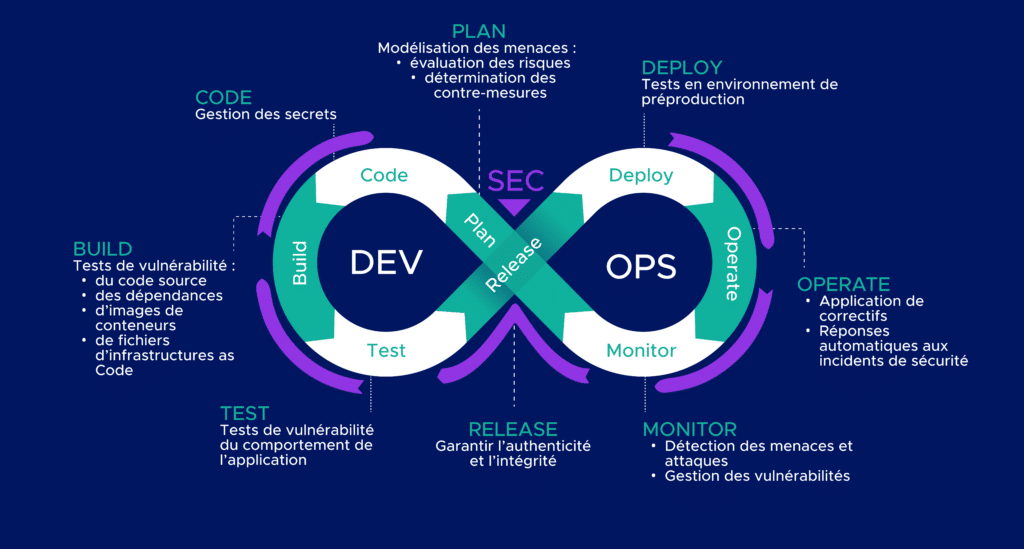
DevSecOps involves integrating security into every stage of the software development lifecycle, using automated processes.
This approach is based on the ” shift left” principle, which aims to detect vulnerabilities early in the development process, directly at the code level.
Specifically, there are tools thatautomatically analyze code and dependencies to identify vulnerabilities as soon as they are introduced.
These checks are then integrated into CI/CD pipelines, which automate the various stages of development and deployment. Every time the code is modified, security tests are triggered automatically:
- static application security testing (SAST),
- dependency scan (SCA),
- dynamic testing (DAST).
This automation enables continuous vulnerability detection without manual intervention.
DevSecOps is not limited to anticipating risks; it also includes continuous monitoring in production (shift right) to detect abnormal behavior or attack attempts in real time.
The Benefits of the DevSecOps Approach
Improving Safety to Keep Timelines and Costs Under Control
This is obviously the primary benefit: addressing security issues from the outset to avoid costly and time-consuming fixes.
Increase customer trust and satisfaction
Safety is now a priority and is considered a measure of quality. Customers can be confident that they are receiving a product that complies with legal obligations and other safety requirements.
Improving Team Agility
Sudden reversals involving significant changes may be met with resistance and misunderstood by teams. Gradually implementing small changes helps teams remain agile.
Essential DevSecOps Tools
Nous ne détaillerons pas cette partie car nous avons déjà rédigé un guide dédié aux meilleurs outils DevSecOps.
Key points:
- These tools make it possible to automate security checks.
- They are integrated directly into the CI/CD pipelines.
- They cover several levels: code, dependencies, infrastructure, and production.
- They facilitate the implementation of “shift left” by detecting vulnerabilities early in the development process.
Good DevSecOps Practices
Raising Awareness and Training Teams
DevSecOps being a new culture, the involvement of teams in its implementation is essential. For this, it is important that they are sensitised and trained on the topics concerning them. They will then integrate new security habits, for example, good management of secrets. This one is less complex to implement than other practices but can nevertheless generate critical vulnerabilities.
Planning Security
To integrate security as early as possible in the cycle, it is necessary to anticipate its implementation. To do this, a phase of reflection and analysis helps to identify potential threats and risks to the project, and to determine if countermeasures are necessary. It is during this stage that security tests are chosen and planned.

Automatiser des tests de sécurité

These allow for the identification of vulnerabilities in both container images and third-party code, as well as in the formality and runtime behavior of the source code.
Automating them throughout the cycle allows more time for teams to perform high-value tasks.
Implementing Security Monitoring

It is also necessary to monitor security events. For this, the monitoring system must gather various information and correlate it to detect threats and security incidents. After their identification, the monitoring system must be able to issue alerts. Finally, the security status of the system must be visualizable.
However, integrating these best practices does not guarantee the proper implementation of DevSecOps.
Take Back Control of Your Cloud
How to implement this approach in your company?
The implementation of the DevSecOps approach is similar to that of DevOps. Therefore, it is necessary to adopt this new culture and integrate its new processes and tools.
Datadog Case Study
Security engineers temporarily joined development teams to raise awareness about security. This made it clear to the Devs that the Secs were there to support them, to help improve the quality of their code by enhancing its security. This also made the Secs realize that they could lack agility and be too slow compared to the developers’ production pace.
The goal was then to automate security using tools. Several conclusions were drawn:
- Security test feedback must be fast to keep up with the Devs’ pace.
- Alerts should not necessarily be sent to security teams. Some can be sent to the Devs with resolution instructions.
Après avoir utilisé les outils du marché, ils ont décidé de créer leurs propres outils de tests statiques et d’analyses de la composition logicielle, plus adaptés à leurs besoins.
DevSecOps FAQ
What is the salary of a DevSecOps engineer?
A career as a DevOps engineer guarantees you a good salary, whether in Switzerland or anywhere else in the world. Salaries vary depending on:
- la région,
- experience,
- the size of the company,
- the industry.
What does a DevOps professional do?
Simply put, DevOps is a way of working that brings developers (Dev) and systems/infrastructure teams (Ops) closer together.
DevOps is used to build, test, and deploy applications faster and more reliably.
💡 We’ve written a comprehensive article here that covers everything you need to know about the roleof a DevOps engineer, and here’s an article about the role of a DevOps consultant.
How Do You Become a DevSecOps Professional?
Most professionals come from the fields of software development, systems engineering (DevOps), or cybersecurity, and hold a master’s degree. In Switzerland, the key steps are generally:
- It is often recommended to gain a solid foundation in computer science by earning a bachelor’s degree (HES/EPF) in computer science, information systems, or cybersecurity.
- Earn recognized certifications, such as the one from the prestigious DevOps Institute.
In conclusion, the DevSecOps approach aims to integrate security throughout the DevOps chain. This makes it easier to secure critical or complex systems and improves customer satisfaction and cost control.
However, this approach is not suitable for all projects. The level of its implementation will also depend on other factors such as team skills, time, and resources allocated to the project.
Our Cloud & DevOps Solutions department is available to discuss your DevSecOps projects and assist you in its implementation.